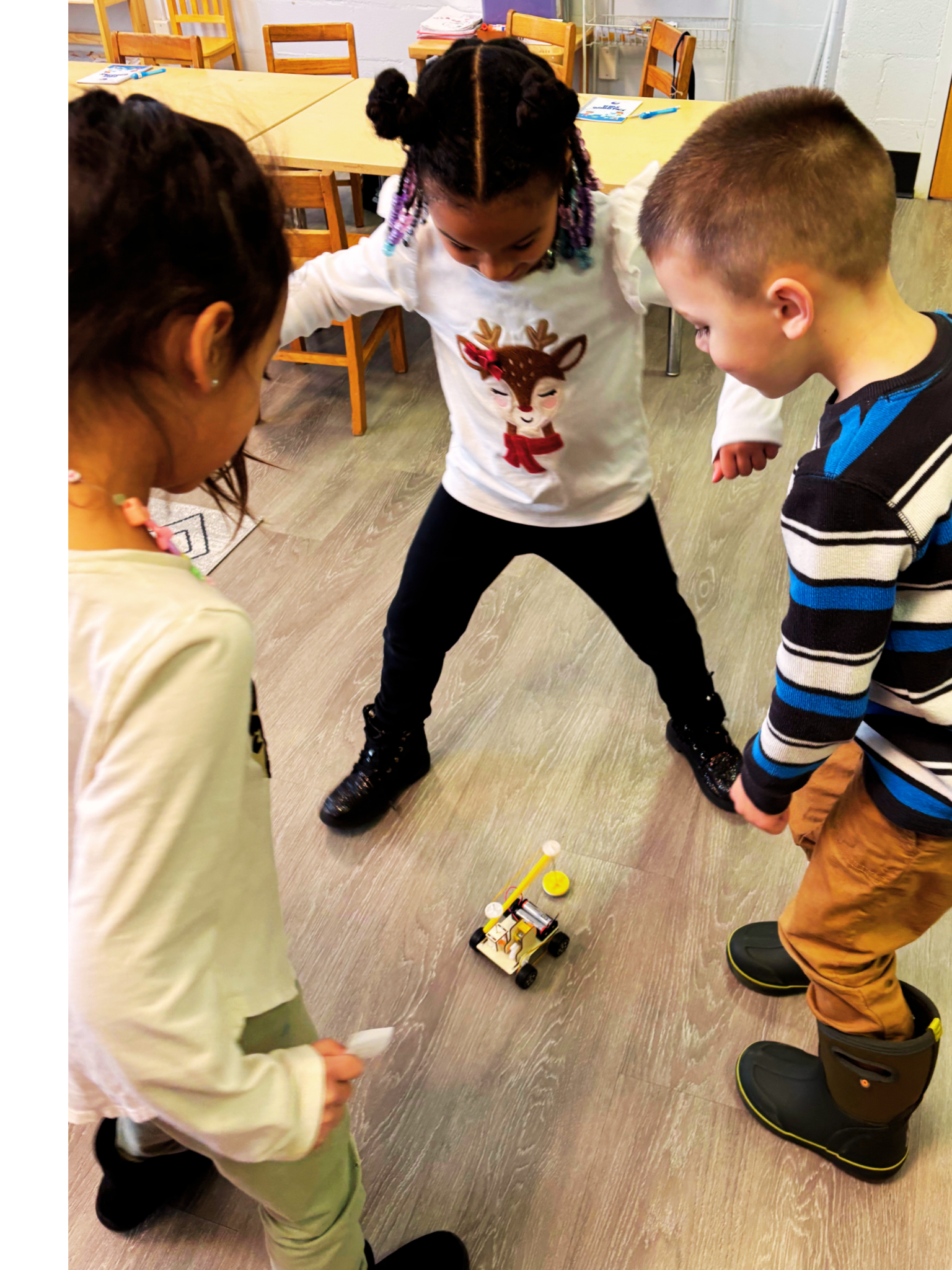
Every time I ask a new student what they think coding looks like, they picture a dark room and a blinking cursor. By the end of their first robotics class, they've already built something that moves, beeped, or crashed into a wall — and they're laughing and asking when we do it again.
Robotics is the best gateway into STEM because it refuses to be abstract. You can't quietly disengage when your robot is rolling off the table.
1. It's Physical and Immediate
Most STEM subjects ask kids to learn before they do. Math requires mastering operations before you can solve real problems. Science often means watching demonstrations. Robotics flips this entirely — kids build first, and the concepts follow naturally. When a child wires a motor backwards and the robot spins the wrong way, they've just discovered polarity. No lecture needed.
The feedback loop is fast. In a coding exercise on a screen, a mistake produces an error message. In robotics, a mistake produces a robot that falls off the table — and a room full of laughter. That physical, immediate consequence is what keeps kids engaged.
2. It Teaches All Four STEM Pillars at Once
A single robotics session touches all of them:
- Science — forces, friction, gear ratios, electricity
- Technology — sensors, microcontrollers, digital logic
- Engineering — structural design, prototyping, iteration
- Math — measurements, angles, ratios, counting loops
No other single activity delivers that breadth. A child who spends six weeks building robots is touching concepts they won't officially "study" for years — and they're absorbing them through experience, which means they'll stick.
3. Failure is Built Into the Process
In most school environments, failure carries a grade. In robotics, failure is the lesson. We call it "quick to fail, quick to learn" — and it's one of the most important things we teach.
When a robot doesn't work, the instinct isn't to give up — it's to debug. Where's the loose wire? Is the code sending the right signal? Did the wheel slip off the axle? Kids who learn to debug robots learn to debug problems in general. That habit of mind is worth far more than any specific skill they pick up along the way.
4. Every Kid Can Access It
You don't need to be "good at math" to love robotics. You don't need to be a natural coder. We've seen kids who struggle in traditional classrooms completely light up when given a motor and a gear. Hands-on, spatial, creative learners thrive in robotics environments — often the same kids who sit quietly in the back of a math class.
That's one of the reasons we start with robotics at Launch Hub. It's the widest door into STEM we know.
5. It Builds Real Confidence
There's a specific look a child gets when their robot does the thing they designed it to do. It's not just happiness — it's the face of someone who just discovered they can build something that works. That confidence compounds. It shows up in how they tackle the next challenge, in how they approach problems at school, in how they talk about themselves as learners.
That's what we're really building, class by class.
We offer in-school programs and campus classes across the DMV area. Rolling registration — join any session.
Browse Courses